Alessandro Abate
About
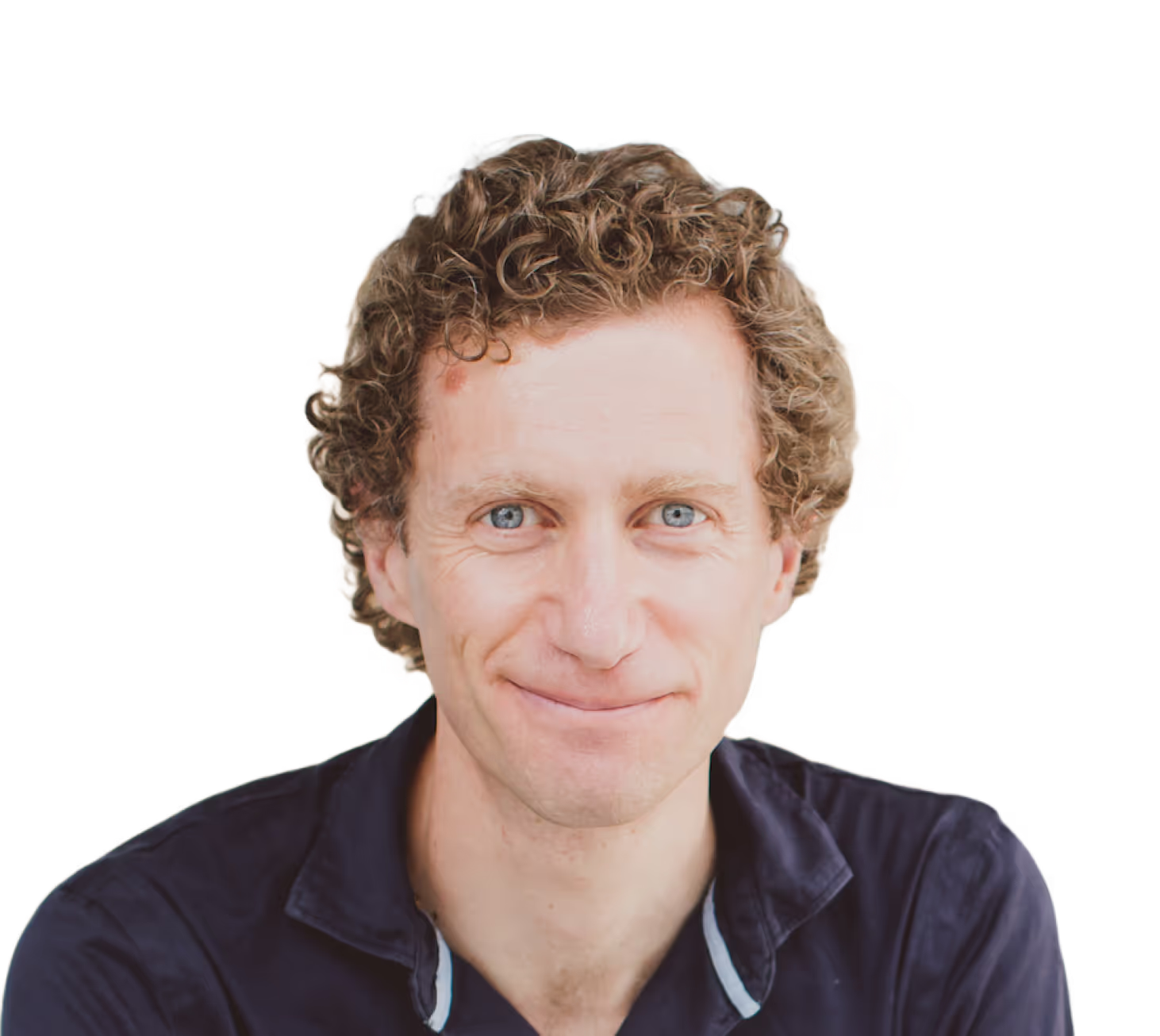
Professor Alessandro Abate is an internationally recognized authority in artificial intelligence, control theory, and formal verification, with over twenty years of experience advancing the frontiers of computational science and trustworthy machine learning. Currently a Professor of Verification and Control at the Department of Computer Science at the University of Oxford, he has built a career that bridges rigorous academic research and real-world impact in critical systems, from autonomous robotics to medical AI.
A graduate of the University of Padua with top honors, he earned his PhD in Electrical Engineering and Computer Sciences from the University of California, Berkeley, where he was awarded the prestigious Leon O. Chua Award for outstanding research in nonlinear science. Before joining Oxford, he held research and teaching positions at Stanford University and TU Delft, where he pioneered the use of probabilistic models in complex dynamic systems. His academic leadership includes over £4.5 million in funded research, collaborations with institutions such as the Alan Turing Institute and Airbus, and more than 260 peer-reviewed publications cited over 7,000 times. He is a Fellow of the IEEE Control Systems Society and has received numerous international honors, including the Gödel Research Prize and the VENI Grant for scientific excellence.
At Oxford, Professor Abate leads the OXCAV group a research lab dedicated to the verification, control, and learning of autonomous and AI-driven systems. His work focuses on developing mathematically grounded methods that ensure machine learning models are reliable, transparent, and explainable principles that lie at the heart of the next generation of clinical AI.
Within Salute Futura, Professor Abate provides the scientific and ethical foundation for the company’s artificial intelligence strategy. His research directly informs the probabilistic engines behind Salute Futura’s simulation and prediction platforms, enabling safe and interpretable AI solutions for healthcare. His collaboration exemplifies the union of rigorous academic science with real-world clinical innovation transforming how medical data is analyzed, modeled, and trusted in practice.